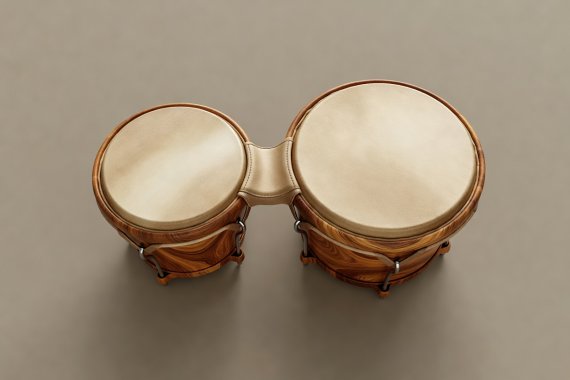
A drum only sounds as relaxed as the hands striking it. In this first unit, we study the physical geometry of the bongos—originating in eastern Cuba's changüí and son traditions around Guantánamo and Santiago de Cuba—and learn how to produce resonant tones without straining your wrists or bruising your knuckles.
Bongos are composed of two shells joined by a central wooden block (the bridge). The smaller drum is called the macho (typically 6.5 to 7 inches in diameter) and the larger drum is the hembra (8 to 8.5 inches). If you are right-handed, place the macho on your left and the hembra on your right so your dominant hand has free access to the lower drum for punctuation and solo accents.
Sit forward on an armless chair or folding wooden stool so your sit-bones carry your weight and your thighs slope very slightly downward. Tuck the bongos securely behind the kneecaps, resting the bottom rim of each shell against the fleshy upper curve of your inner calves. Tilt the top heads slightly away from your torso (roughly 10 to 15 degrees). This subtle outward tilt ensures that when your forearms drop naturally, your fingers meet the drumhead flat rather than chopping into the sharp steel crown rim.
Figure 1.2 — Outward 15-degree tilt keeps the wrist joint straight and protects the proximal finger joints from striking the metal hoop.lesson 1.2 • tone vocabulary
The Four Fundamental Strokes
Unlike larger conga drums that employ the entire palm, bongo technique relies primarily on the pads of the index, middle, and ring fingers, assisted by the base of the palm and thumb for timekeeping. Practice each stroke individually at 60 BPM before combining them:
O
Open Tone (Abierto)
Strike the outer third of the drumhead with the three middle fingers together, letting the first knuckle kiss the rim edge and rebound immediately like touching a hot kettle. The skin must vibrate freely.
M
Muted Stroke (Tapado)
Use the same finger placement as the open tone, but allow the fingers to remain resting lightly on the head after impact. This cuts the sustain and produces a dry, woody pitch slightly higher than the open tone.
H/T
Heel-Tip Rock (Manoteo)
Executed by the left hand on the macho. Drop the fleshy heel of the palm near the center ("Heel"), then pivot downward so the fingertips tap lightly ("Tip"). Or pivot between the side of the thumb and the three fingers.
S
Rim Slap (Seco)
While the left-hand fingers press gently into the macho head to tighten the membrane, the right index and middle fingers whip briskly near the bearing edge to create a crisp, articulate pop.
lesson 1.3 • internalizing time
Vocal Subdivisions & The Walking Pulse
In outdoor settings, sound dissipates rapidly into the grass and trees. Without room reflections, beginners often accelerate unconsciously because they cannot hear the tail of their previous note. The remedy is coupling your hands to spoken syllables and a gentle heel tap on the ground.
Use the interactive reference control below to select a rehearsal tempo between 60 and 92 BPM. Speak the syllables "Ga - Ka - Ga - Ka" or "1 - & - 2 - &" out loud for two full measures before letting your fingers touch the drum.
At 72 BPM, each quarter-note beat lasts 0.83 seconds. If your shoulders rise or your breath feels shallow during Exercise 1A below, reduce your metronome by 6 BPM immediately.
Exercise Code
Spoken Count
Drum & Stroke Assignment
Mastery Benchmark
Ex 1A: Single Voice
1 — 2 — 3 — 4
Right hand Open Tone on Hembra on every beat; left hand rests lightly on knee.
2 minutes nonstop at 68 BPM with even volume across all four beats.
Ex 1B: Alternating Shells
1 & 2 & 3 & 4 &
Left Muted on Macho on numbers (1,2,3,4); Right Open on Hembra on off-beats (&).
Clear pitch separation between the dry high macho and ringing low hembra.
Ex 1C: Breathing Bar
Three bars play / One bar spoken
Play Ex 1B for Bars 1–3; lift hands 3 cm above heads for Bar 4 while counting aloud.
Re-entering on Beat 1 of Bar 5 without rushing the silent fourth measure.
We use cookies We use necessary cookies to run the site and, with your consent, optional ones to measure visits. You can change this at any time. Read more