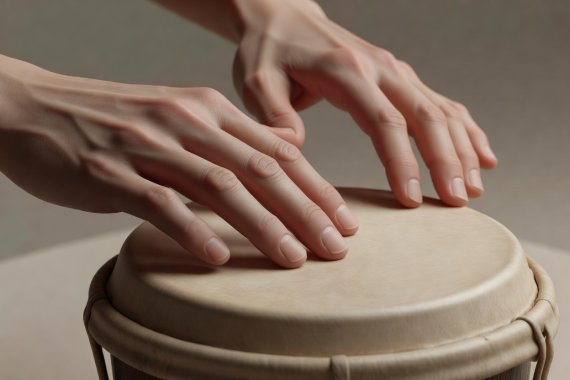
Beginners often treat left and right hands as competing drummers trying to superimpose two rhythms. In conservatory hand percussion, both hands form a single interlocking gear. When your left hand rocks down on the beat, it automatically lifts your right hand to drop onto the off-beat.
Prerequisite: Unit I (Steady 1A–1C at 72 BPM)Core Pattern: Traditional Martillo (8 Eighth-Notes)Reference Study: John Santos & Trevor Salloum Method
lesson 2.1 • left-hand engine
The Thumb-Finger Rocker on the Macho
In traditional Martillo (Spanish for "hammer"), the left hand never leaves the surface of the smaller macho drum. Instead, it acts like a quiet pendulum marking all four main beats (1, 2, 3, and 4) while changing the tension of the drumhead for the right hand.
Place the side of your left thumb near the center of the macho on Beat 1. As the thumb rests on the skin, your left index, middle, and ring fingers hover 2 centimetres above the upper edge. On Beat 2, rock the wrist forward so the three finger pads press down onto the head while the thumb lifts slightly. On Beat 3, rock back to the thumb (or palm heel), and on Beat 4, rock firmly onto the thumb again so the head is damped when the right hand moves over to strike the larger hembra.
Figure 2.2 — Contact zones on the macho: central thumb/heel pivot point and upper finger-pad damping zone.lesson 2.2 • right-hand melody
Assembling the Complete Martillo
Once your left hand can rock steadily through "1 - 2 - 3 - 4" with your eyes closed, the right hand fills every "&" off-beat between those movements. Because the left hand is pressing down on Beat 2, the right hand's strike on the "& of 2" produces a sharp, high-pitched rim slap. Because the left hand lifts its fingers on Beat 3, the right hand's strike on the "& of 3" rings as a clear open tone.
Finally, on Beat 4, the right hand travels 15 centimetres to the right to strike a resonant, open low tone on the hembra—either directly on Beat 4 (standard son feel) or on both Beat 4 and the "& of 4" depending on the ensemble song structure.
step-by-step practice layering
Layer 1 (Left Hand Alone): Play Thumb (1) – Fingers (2) – Thumb (3) – Fingers (4) quietly at 68 BPM for 16 bars.
Layer 2 (Add Beat 4 Hembra): Keep the left hand rocking, and strike a single right-hand open tone on the hembra on Beat 4 only.
Layer 3 (Fill the Off-Beats): Insert the right-hand strikes on the "&" of 1, 2, 3, and 4 while keeping the left hand at half the volume of the right.
lesson 2.3 • ghost notes & variations
Dynamic Contrast & Three Companion Grooves
If all eight notes of the Martillo are played at the same loudness, the rhythm sounds mechanical—like a typewriter rather than a dance groove. The secret to professional tone is the 3:1 Dynamic Ratio: your unaccented left-hand rocker notes ("ghost notes") should sit around 30% volume, while the "& of 2" slap and Beat 4 hembra open tone sing out at 90% volume.
Pattern Name
8-Subdivision Grid (1 & 2 & 3 & 4 &)
Musical Application in the Garden
Standard Martillo
L(h) R(m) L(t) R(S) L(h) R(o) R(H) L(t)
Universal foundation for mid-tempo acoustic circles, folk-Latin guitar songs, and trio rehearsals.
Bolero Support
L(h) R(m) L(t) R(m) L(h) R(H) R(H) R(H)
Slower ballad tempos (56–68 BPM); replaces the sharp slap with three warm open tones on the hembra across Beats 3&, 4, and 4&.
Changüí Drive
R(H) L(t) R(S) L(t) R(H) L(t) R(o) R(H)
Higher-energy call-and-response sections; shifts low hembra accents onto Beats 1 and 3 to anchor dancers or handclaps.
Legend: L(h) = Left Heel/Thumb, L(t) = Left Tip/Fingers, R(m) = Right Macho Soft Rim, R(S) = Right Macho Slap, R(o) = Right Macho Open, R(H) = Right Hembra Open Tone.
We use cookies We use necessary cookies to run the site and, with your consent, optional ones to measure visits. You can change this at any time. Read more